

NWSPEC
Confocal Raman Microscope | Ram-M330 / Ram-M350 Series | NWSPEC
Confocal Raman Microscope | Ram-M330 / Ram-M350 Series | NWSPEC
Confocal Raman Microscope
Ram-M330 / Ram-M350 Series
Product Overview
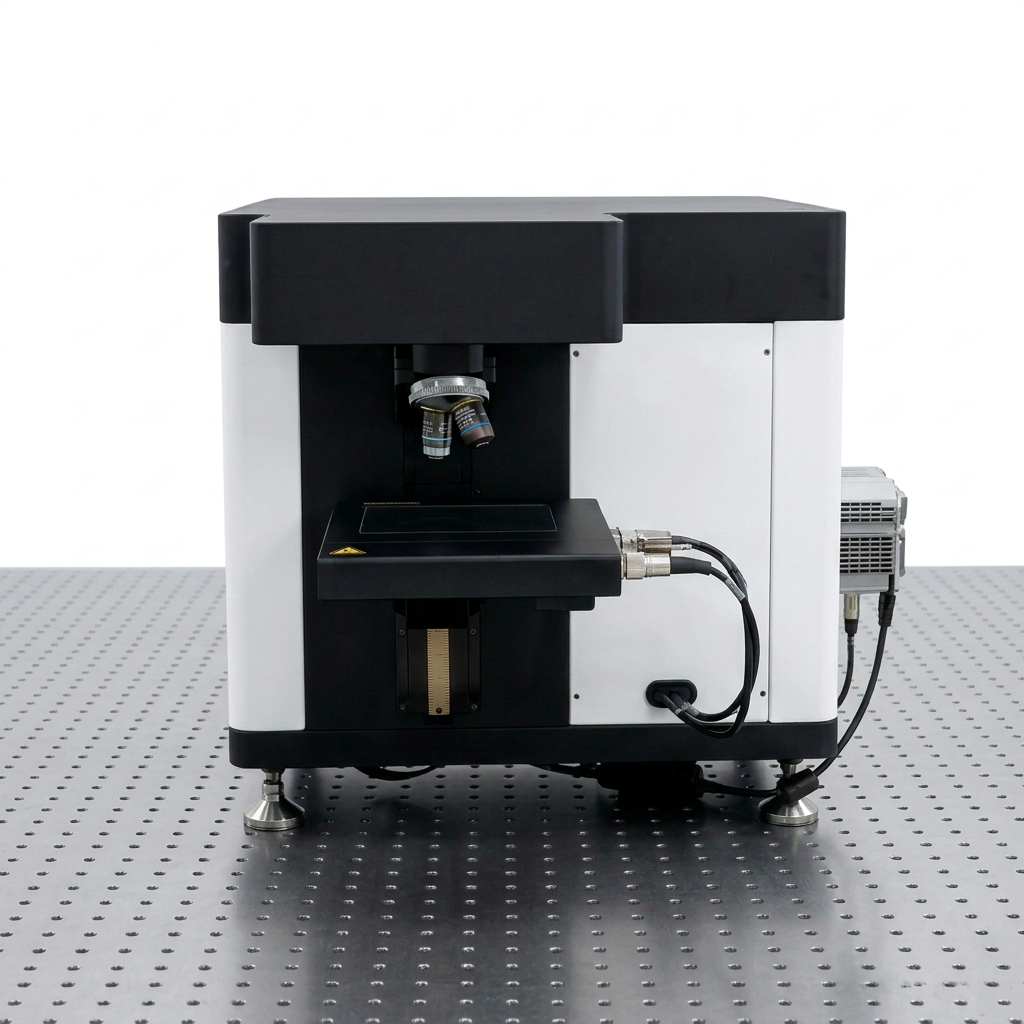
High-sensitivity automated confocal Raman microscope with compact footprint (28.3"W x 31.9"D x 21.8"H). Supports up to three configurable excitation wavelengths (532/633/785nm) for simultaneous Raman and photoluminescence analysis. Spectral resolution better than 0.9 cm-1 (M350) with silicon third-order Raman peak SNR exceeding 30:1. Fully automated operation with optional sample loading integration for unattended workflows.
Key Highlights
High Degree of Automation: Automatic wavelength switching, automatic mode transition between imaging and Raman, integration with automated sampling systems for unattended operation
Excellent Performance: Spectral resolution better than 0.9 cm-1, high sensitivity (Si third-order Raman peak SNR >30), submicron high-resolution Raman imaging (0.5um lateral resolution)
Compact Design: All-in-one integrated optical system, motorized switching for three excitation wavelengths, upright research-grade reflected bright-field microscope
Model Selection Guide
| Feature | Ram-M330 | Ram-M350 |
|---|---|---|
| Focal Length | 330 mm | 350 mm |
| Spectral Resolution | Better than 2 cm-1 | Better than 0.9 cm-1 |
| Best For | Standard Raman analysis, quality control | High-resolution research, advanced materials |
Wavelength Configuration Order Guide
System supports up to three excitation wavelengths (532/633/785nm) with fully motorized, software-controlled switching. Select any combination: single wavelength, any two wavelengths, or all three wavelengths.
How to Configure Your System
| Configuration | Select Any Combination | Best For |
|---|---|---|
| Single Wavelength | Choose 1 from: 532nm, 633nm, or 785nm | Dedicated applications with known sample types, budget-conscious setups |
| Dual Wavelength | Choose any 2: 532+633nm, 532+785nm, or 633+785nm | Mixed sample workflows, flexibility for both inorganics and organics |
| Triple Wavelength | All 3 wavelengths: 532+633+785nm | Maximum versatility, multi-user facilities, research environments with diverse samples |
Wavelength Specifications
| Wavelength | Power | Primary Applications | Selection Guidance |
|---|---|---|---|
| 532 nm | 100 mW | Carbon nanotubes, graphene, SERS, semiconductors, inorganics | Highest sensitivity. Best for carbon materials and inorganics. Avoid for highly fluorescent samples. |
| 633 nm | 35 mW | Forensics, fibers, minerals, corrosion studies, general unknowns | Balanced performance. Good fluorescence suppression vs 532nm. Ideal for forensic and mineral analysis. |
| 785 nm | 100 mW | Pharmaceuticals, biological tissue, proteins, oils, dyes, polymers | Best fluorescence suppression. Industry standard for organic applications. Safest choice for unknowns. |
Which Configuration Do I Need?
Single: One sample type only (e.g., carbon materials to 532nm; pharmaceuticals to 785nm)
Dual: Two sample categories (e.g., 532+785nm for inorganics + organics)
Triple: Multi-user facility or service lab requiring maximum flexibility
Recommended Pairings by Application
| Application Field | Recommended Config | Rationale |
|---|---|---|
| Carbon/Nanomaterials Research | 532 nm only | 532nm provides highest sensitivity for carbon structures |
| Pharmaceutical QC | 785 nm only | 785nm eliminates fluorescence from most APIs; industry standard |
| Materials Science (Mixed) | 532+785 nm | 532nm for inorganics/carbon, 785nm for organics/polymers |
| Forensics/Security | 633+785 nm | 633nm for fibers/minerals, 785nm for explosives/drugs/inks |
| Academic Teaching/Research | Triple (532+633+785) | Maximum flexibility; compare wavelength effects on same sample |
| Contract/Service Laboratory | Triple (532+633+785) | Handle any customer sample without limitations |
Optional Configurations
| Option | Function |
|---|---|
| Auto-Focus Module | Image-based auto-focus for uneven surfaces and long-duration mapping |
| Particle Auto-Positioning Algorithm | Automatic particle recognition and laser positioning for API/microplastic analysis |
Additional Configuration Options
Objectives: 10x (NA 0.3), 50x (NA 0.5), 100x (NA 0.9) - 4-position motorized turret
Gratings: 150/600/1800 g/mm with software-controlled automatic switching
Automation Package: Standard motorized XYZ stage (75x50x50mm, 0.05um step) or Full automation with sample loading integration
Application Fields
Verified Performance
Spectral Resolution: 585nm neon lamp test: 0.797 cm-1 half peak width (M350)
Sensitivity: Silicon third-order Raman peak SNR >30:1 (7100 counts signal / 214 counts noise)
Spatial Resolution: Two-dimensional materials mapping: ~0.5um lateral resolution verified
Couldn't load pickup availability

Frequently Asked Questions
How can I contact you?
Feel free to call us T+86 189-6516-4839
or email sales@nwspec.com to:
• Place an order
• Ask for a quote
• Or if you have any other questions
You will always get a live person here at NWSPEC; never an automated system!
We are open from 6:00AM - 7:00PM Eastern Time, Monday - Friday.
Where can I find application notes?
If you have any questions regarding the application notes, or can't find the one you are looking for, please contact Sales at sales@nwspec.com
Do you have instructional manuals for your instruments to download?
Yes, we have instructional manuals for our instruments. They can be found on https://nwspec.com/pages/resource .
If you don't see the one you are looking for, please contact: sales@nwspec.com